
- KAYAKING
After we reached the end of U.S. 1 on Monday, the hotel called to let us know our room was ready, so we went ahead and checked in, and got ready for the main activity we had planned for Monday, a sunset/evening 2 1/2 hour kayak tour with Blue Planet Kayak. We have been kayaking before, but we were looking forward to having a chance to do it in the evening around the mangrove islands. I had made a mistake on the reservations, accidentally signing us up for a tour a week later than I had intended, and the owner, Chad, kindly re-arranged things so we could still go on Monday. One nice feature of the tour was that the tour company would come pick you up from your hotel if you chose (and I think, although he was too kind to say so, that Chad figured it would be a good idea to come pick us up to keep me from getting any more lost than I already was!) so at 6:05, we were at the front of the registration building at Parrot Key Resort waiting in very comfortable rocking chairs.

Promptly at 6:10, the truck from Blue Planet pulled up, and we went on to the meeting spot with the other kayakers (there is a maximum limit of 10 people per tour), and then they followed us over to Stock Island, which is where the tour begins. Stock Island is the key immediately north of Key West; the two are separated by just a small channel. Why Stock Island is an island instead of a Key is beyond me.
Once at the marina, Chad gave us a short introduction to kayaking, one of the best I have ever seen, and then helped each of us into our kayaks. I have to admit that, for me, it is the getting in and out that is the most difficult part of the whole thing. I am not overly gifted with either grace or coordination, and always have pictures of myself overturning the kayak and ending up standing in the bottom of the harbor. However, I made it safely in the kayak, as did Mark, and once everyone was seated, we took off. (We were in a tandem kayak, with me in the front and Mark in the back. )
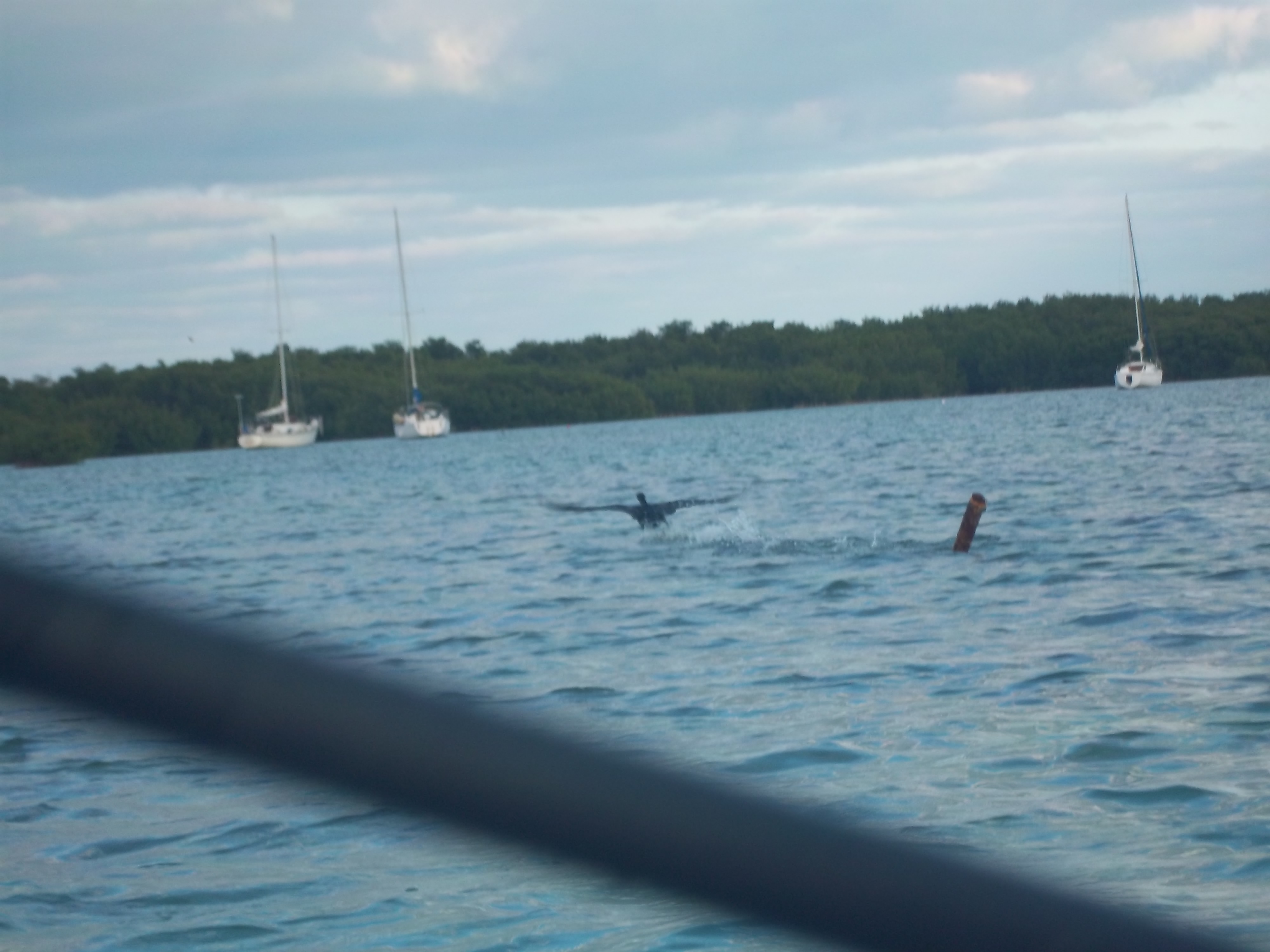
Our destination was a group of mangrove islands in the middle of the bay, but on the way there we saw this black cormorant taking off. The cormorant is streamlined for swimming and diving, but the same adaptations that make it an excellent swimmer and diver make it somewhat ungainly in flight. We watched this cormorant for a while, and it never did get much over a foot above the water!
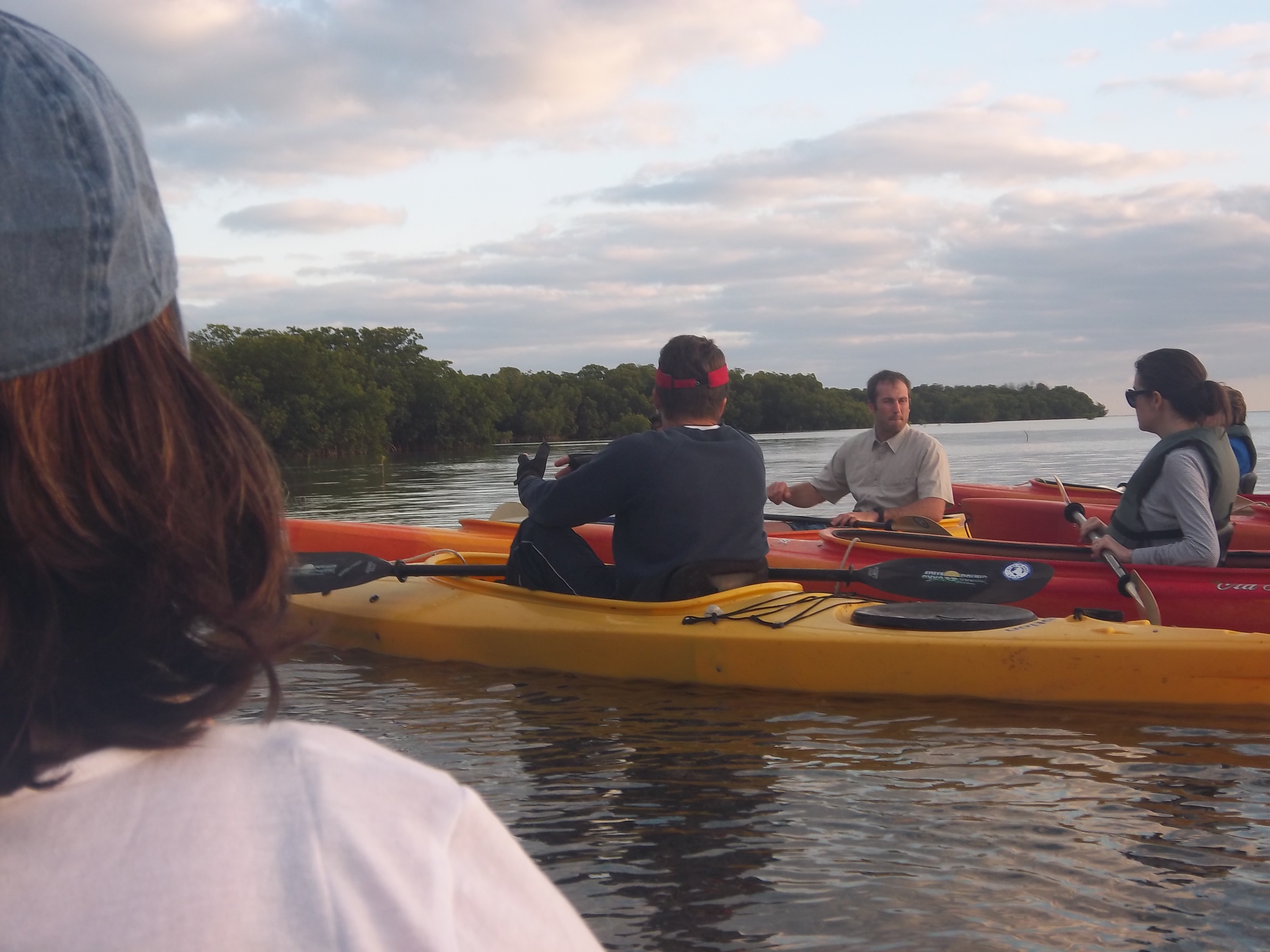
Here our group is in the bay right outside of the mangrove islands. The man in blue, with his back facing me was our guide, Chad. All of the green that you see on the left is made up of mangroves.
Here, we are getting ready to go through a channel in the mangroves. Technically speaking, mangrove islands are not islands at all, simply groups of mangroves that are thickly clustered together. The Florida Keys is the farthest north point at which they grow. The mangroves are well adapted for salt water living; their roots essentially drink the salt water. The roots lifted above, and then curving into, the water are one of the ways in which you can tell a mangrove. These are red mangroves, named for the color of their wood. They can reach 8 to 10 feet in the Keys, but farther south they can reach up to 70 feet tall! The black and white mangroves, named for the color of their bark, can grow to 100 feet tall in the same areas. The channels in the mangroves are caused by currents, or places where the tree canopy closes over the top so much that the light cannot get down to the surface to allow new mangroves to grow.

We went through several mangrove channels. They are exceptionally narrow and twisty and have a spooky kind of beauty all their own. This was especially true at night. I was very grateful that our guide neglected to disclose the fact that there are two types of snakes that can live in mangroves until after we had finished traveling through the mangrove channels! Making it through the mangrove channel in a tandem kayak does require some team work on the part of the two kayakers in the boat, but Mark and I managed it.
Before the night had finished, our guide, and some of our fellow kayakers, had managed to find a horseshoe crab, a spiny sea urchin (the guide lifted him up onto his kayak with a net and it was fun to see the urchin squiggle off back into the water), a sea cucumber and a sea hare, two of God’s uglier creatures, I think, a sea star (starfish to us laypeople) and a Florida lobster. Because of the “supermoon”, it wasn’t possible to see any of the bioluminescent creatures in the tidal flats, but what we did see was very interesting. Florida lobsters, for example, do not have front claws like Maine lobsters do, although they do have very spiny legs. Our guide, as you can tell from this entry, knew a lot about the ecology of the mangroves and tidal flats, and did a wonderful job in communicating his knowledge.
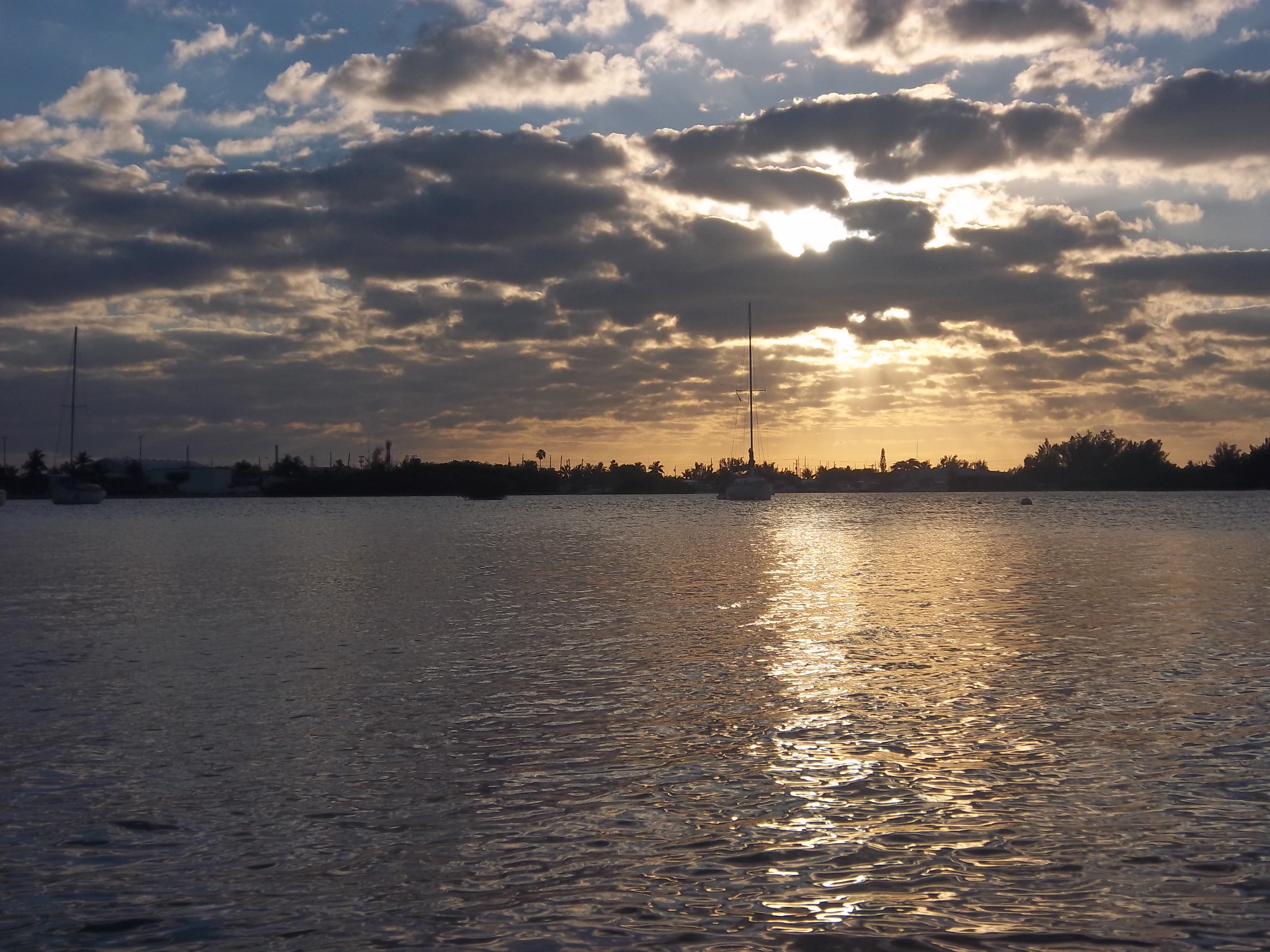
Finally, Mark took this picture of the sunset as we were traveling around the mangrove islands. As beautiful as this picture is, he and I both agree that it doesn’t do justice to the real thing!
Have a great day everyone!
Nancy



 Tales from the Mom-Side