Monthly Archives: May 2014

Bibliophilic Friday: The Elijah Baley Detective Novels


Good morning everyone!

Sun, Summer

From ClickArt Online, by Broderbund

Take one of the geniuses of science fiction, throw in a love of detective novels, add a dash of humor and adventure, and you arrive at the three detective novels written by Isaac Asimov starring plainclothesman detective Elijah Baley and his robot partner R. Daneel Olivaw, The Caves of Steel, The Naked Sun and The Robots of Dawn.  In the introductions to the first two books, Isaac Asimov explains how one of his editors, desiring another robot story, urged him to write a detective science fiction story.  The result was The Caves of Steel.

Set in a time period long after the Susan Calvin stories and the world of I, Robot, yet before the creation of the Galactic Empire that we see the end of in Foundation, the Elijah Baley novels take place in a galaxy where man has colonized fifty other star systems in addition to the Solar System.

The vast majority of humanity has remained on an ever more crowded earth, where the sheer volume of people has caused human kind to build downward, creating huge underground cities where people live their entire lives, never seeing the sun or “going Outside” as it is called.  The fifty Spacer worlds, by contrast, are relatively sparsely inhabited.  The Spacers, as they are called, see themselves as vastly superior to Earthmen – they have completely eradicated infectious diseases of all kinds on their planets, even the common cold and have natural life spans of over 300 years.  Because of the infectious diseases, the Spacers are also terrified of infection by Earthmen.  With little want on their planets as well as strictly controlled birth rates, the Spacers do not have police forces per se the way that Earth does.  There is another significant difference between the two cultures – Earth’s people do not want to use robots, but the Spacers depend upon them.  However, at the time the novels begin, robots are starting to be introduced into earth’s economy as well.  Daneel Olivaw is the first of his kind, a “humaniform” robot – a robot meant to be as much like a human being as it is possible for  a robot to be.

In the first novel, Elijah and Daneel work together for the first time to solve the murder of a prominent spaceman on Earth, while in the second novel, the two work together on the newest Spacer world, Solaria, to solve the murder of a scientist.  In the third novel, the pair meet one more time to solve the “murder” of the second humaniform robot ever created on the most prominent Spacer world of all, Aurora.

Isaac Asimov skillfully blends the genres of detective fiction and science fiction creating characters and settings that are  believable and consistent within the world that he has created.  Each novel kept me on the edge of my seat until I could find out who the culprit was.

I would not hesitate to let any child at a sixth grade reading level  or higher to  read The Caves of Steel or The Naked Sun.  I would suggest that parents read The Robots of Dawn before allowing their children and teenagers to read it, simply because the issues surrounding sexual mores and knowledge are tackled in a frank, open manner that some parents may feel is not age appropriate for those age groups.

Still, nothing beats a good detective story for an entertaining read.  Add in Isaac Asimov’s unique writing talents and a fascinating universe, and you have a combination that makes these three novels exceptionally good reads.  Whether you are a detective fan or a science fiction fan, give them a go!  You’ll be glad you did.

Have a great weekend everyone!

Nancy

Kayla’s Turn: Photo Essay, Charlotte, North Carolina


Good morning Everyone!

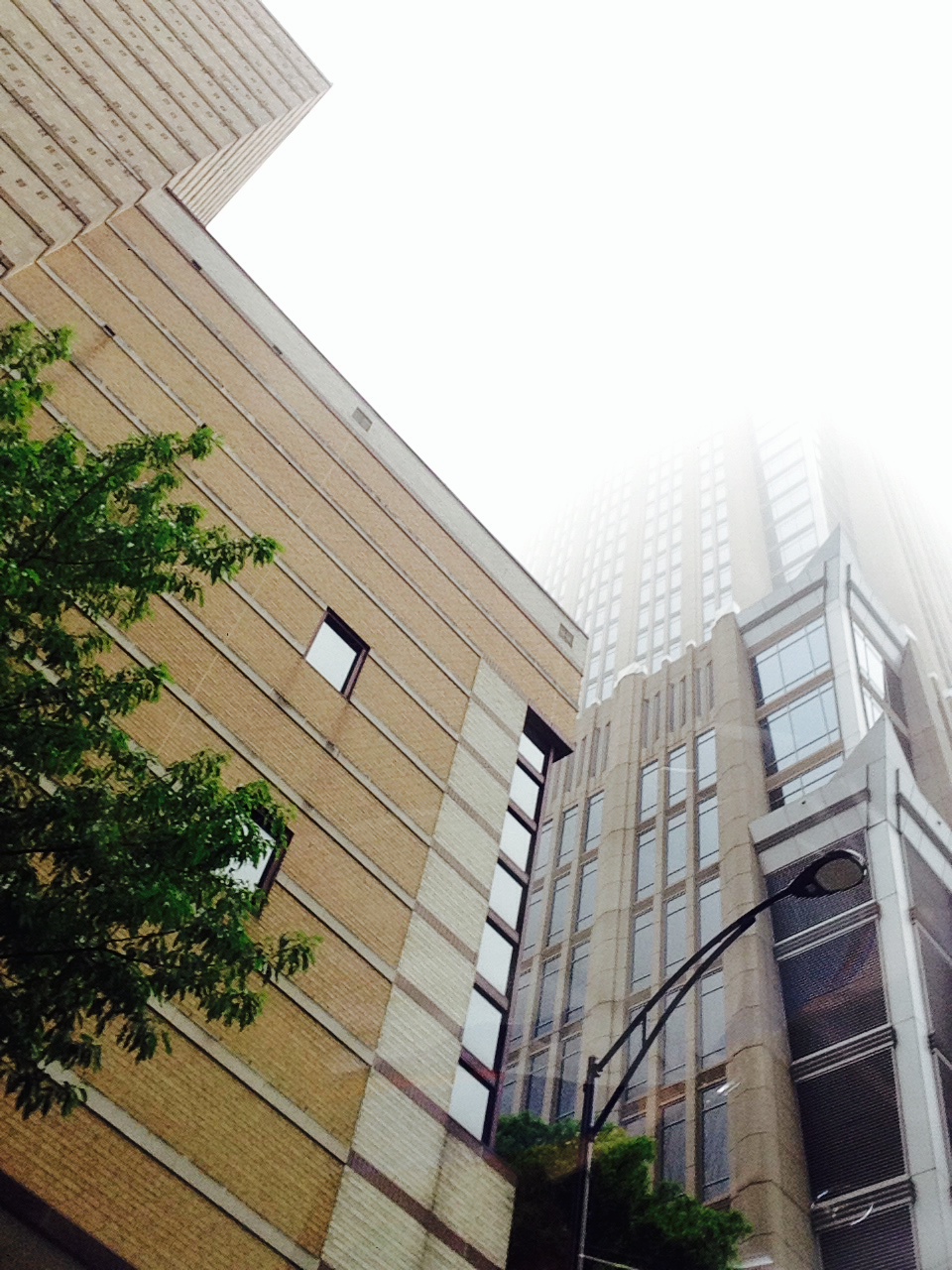
When Mark and I first married, we lived in North Carolina for three years.  While most of that time was spent in a small town called Rockingham, North Carolina, we did have the opportunity to live for at least a few months in Charlotte, North Carolina.  Even back then, in the late 80’s, Charlotte was a beautiful city.  It ended up being one of the places we enjoyed living in most out of everywhere we’ve been.  We had a chance a few weeks ago to go back to Charlotte for the first time, and we took Kayla with us.  While we were driving through downtown Charlotte, Kayla took the following pictures, which I think (proud mama alert!) are quite extraordinary for a 12-year-old armed with only an iPod.

Charlotte, North Carolina

This one is probably my very favorite of all of the pictures that she took.  One of the unique features of Charlotte is the quantity of trees the city, even the downtown, still has.  Early on in its urban development, Charlotte’s city fathers passed ordinances requiring trees to be kept intact whenever possible.

Charlotte, North Carolina

Charlotte got its start as a town in the first gold rush that ever occurred in the United States – gold was found in Charlotte in the early 1800’s. Now the city is a financial services mecca, headquarters to many different banks and other financial institutions.

photo 1


We were riding through on a misty morning, and the tops of the skyscrapers were hidden in the clouds, a fact that fascinated Kayla.

photo 2


I, of course, hardly recognized anything downtown from when we lived here over twenty years ago, and yet I still recognized the spirit of the city.  The city that can maintain the balance between old and new and still retain its original identity is a rare city indeed.  But then, that’s Charlotte!

photo 3


Have a great day!

Nancy

Actually At Risk


Good morning Everyone!

Somewhere over the course of the last ten years or so, two phrases have steadily infiltrated American English to the point that they are becoming seriously irritating to me. especially when I hear them used by people on TV.  Those two phrases?  “Actually” and “at risk.”

“At risk” is a phrase promoted by the 24 hour news media crowd – after all, “Your child is at risk for measles” sounds exponentially more urgent than “one out of 1000 children catch measles each year.”  (None of the children in the United States should catch measles; they should be vaccinated against them instead.)  If I am told I am at risk for heart disease, flu or just catching a cold, I am instantly more concerned than if I am told that there is merely a chance that I could develop or catch the same thing.   What the people using that phrase don’t mention is that I am also at risk for winning the lottery, flying to the moon and winning the Nobel Peace Prize – but I’m not holding my breath for any of those things to happen soon, either!

“Actually” has become an overused meaningless filler word.  Most of the time, I hear “actually” in sentences such as “I actually went to the store and bought groceries.”  Well, yes, I assumed you did “actually” go to the store; I didn’t think you sent your evil twin instead.  I suppose there is the argument that “actually” is meant to indicate personal presence as opposed to “virtual” which would indicate that a person viewed or did something by computer, but most of the people who use the word interminably are not trying to be that precise.  I think people use “actually” now much in the way we used to say “ummm…” when we didn’t know what to say.  I think it’s time we stopped “actually” doing things, and simply started  doing them, but then that’s just me.

I, of course, catch myself using both phrases far too often

Because I am actually at risk for having to go to work today, I better close for now.

If you have any pet vocabulary or grammar peeves, I’d love to hear about them!

Here’s hoping that all of you are actually at risk for having a great day today!

Nancy

Bibliophilic Friday: Robots and Foundation


Good morning Everyone!

Robot from Print Shop Professional 2.0

I have been (sort of) participating in a WordPress Challenge called “Blogging 201,” which is designed to help bloggers improve their blog.  One of its suggestions is to have at least one weekly feature, so here’s mine:  Bibliophilic Friday.  All the feature really does is give me a chance to talk about some of the many, many books that I love.  I’m not entirely sure that you can be a writer if you don’t also love to read; at least I couldn’t.

We’re going to start with  Isaac Asimov’s Robot series and Foundation series, mostly because that is what I have been reading for the past few weeks.  Many of you are probably familiar with the movie “I, Robot”, which was (very) loosely based on Isaac Asimov’s work.  The movie, however, is nothing at all like the book.  While I did enjoy the movie, as in most cases, the book is much better.  The Isaac Asimov book, I, Robot, is basically a group of short stories tied together by the theme of an interview with robotics expert Susan Calvin that traces  the history of the positronic robots in Asimov’s imaginary future world from their beginnings towards the point where they are an integral part of the world.

One of my favorite stories in the book tells the trials and tribulations suffered by a two-man field team of robotics experts whose job is to test all of the new robots that are developed by the company.  In this particular story, they have been assigned to assemble and teach a new group of robots to handle an energy beam for earth; the energy beam has to be directed “just so”, or it will lose focus and end up frying major cities such as London or L.A..  The most important jobs the robots have is to keep the beam focused during radiation storms in space.  Well, our intrepid duo puts together a robot, who, with its positronic brain, deduces that it would be impossible for the men to have created it, given how much flimsier and less intelligent the men are then it.  Instead, the robot decides that its creator is the computer running the energy beam and that the job of all is to serve it.  It also deduces that the computer creator has given the men the delusion that they created the robots out of kindness and concern for their weakened condition.  The robot also converts all of the other more primitive robots in the energy station.  When one of the men gets frustrated and says something negative (ie., expletive deleted) about the energy beam computer, the men are locked out of the control room for blasphemy. The story goes forward from there.  It is really very funny!  The other stories in the book are equally entertaining, with just the right mix of humor, emotion, intellectual challenge and sometimes even pathos.

After re-reading #25 or so of  I, Robot, I decided to read Isaac Asimov’s Foundation Trilogy.  It is considered one of the cornerstones of modern science fiction but I just never had gotten around to it.  I am delighted that I finally did!

The original three novels are the kind of books that you have to stay up until midnight reading just because you can’t wait to see what happens next.  There are two prequels (actually written after the first three novels) that are just as exciting.  In the Foundation books, a mathematician named Hari Seldon has developed a system of mathematics called psychohistory that is capable of predicting the future based upon the acts of billions of individuals.  At the time of the book, mankind is spread out over millions of worlds and part of a galactic empire that has existed for tens of thousands of years, but which is about to fall.  Seldon uses his branch of mathematics, psychohistory, to develop a plan that will reduce the period of  “the dark ages” that would result from the collapse of the Empire from 10,000 to 1000 years, and the first three books are about the plan during is first 400 or so years of existence.  The prequels are, of course, about Hari Seldon and how his psychohistory and the Foundation that supported it was developed.  (There are at least two other, later Foundation novels, but I haven’t read them yet so can’t recommend them.)

One fascinating development since Asimov wrote the Foundation novels is that something approaching psychohistory seems to be developing today.  There are people working on developing models that will use all of the data, chatter, discussions and decisions out on the Internet in order to predict future geopolitical events.  Google  and Bing already do some predicting on an individual basis – if you’ve ever noticed, while you’re writing a search query, they busily try to give you choices on what you are trying to ask based on what they predict your questions to be.

So, for you science fiction fans out there, what is your favorite Isaac Asimov science fiction book?  If you are a fan of some of his non-fiction work popularizing different sciences, let me know which one of those are your favorites!  I can’t wait to hear from you!

Have a great day!

Nancy